
Email Advertising Cost: A 2026 Breakdown & How to Cut It 99%
Confused by your email advertising cost? This guide breaks down hidden fees from ESPs and reveals how to cut your bill by 99% using direct infrastructure.

On this page
Most advice about email advertising cost starts from the wrong premise. It assumes the bill from your email platform is just a normal cost of growth, like warehousing or payment processing. It isn’t.
In practice, a lot of that bill is a middleman tax. The software looks like the product, but the actual sending layer underneath is often cheap infrastructure sold back to you with a heavy markup. If your monthly spend keeps climbing every time your list grows, that’s not always because email is expensive. It’s often because the pricing model is designed to get more expensive faster than the underlying delivery cost.
That matters even more for e-commerce and DTC brands running segmentation-heavy programs. If you’re building more targeted campaigns, this guide to e-commerce ad segmentation is a useful reminder that better targeting usually creates more variants, more sends, and more pressure on your tooling. If the platform charges like a landlord every time your list or send volume rises, good marketing gets punished by bad economics. That’s one reason founders start looking for cheap Mailchimp alternatives once the bill stops matching the actual value.
Why Is Your Email Bill So High? The Hidden Truth
If your email bill keeps rising, the usual explanation is simple: your list grew, so your cost grew. That sounds reasonable. It’s also incomplete.
Traditional email platforms rarely price around the actual act of sending email. They price around subscriber tiers, feature bundles, and platform dependency. So your bill doesn’t reflect only what your campaigns consume. It reflects what the platform can charge once your email program becomes operationally hard to move.
What most businesses assume
A lot of teams believe they’re paying for deliverability, automation, templates, analytics, and reliability as one clean package. They are paying for those things. But they’re also paying for a layer of markup between them and the infrastructure provider doing the send.
That distinction gets missed because the invoice hides it. You see one platform fee, one subscriber cap, and one upgrade prompt. You don’t see the cheap sending rails underneath.
Practical rule: If your platform cost rises much faster than your actual sending complexity, you’re probably paying for pricing architecture, not delivery.
Why the bill feels normal until it doesn’t
Early on, the monthly charge looks manageable. Then the list grows. You add flows, campaigns, and segments. Suddenly email starts behaving like rent. Every improvement in retention marketing pushes the bill up again.
That’s the trap. Email should become more efficient as your program matures. Instead, many businesses watch one of their best-performing channels become a line item they feel slightly resentful about funding.
The hidden truth is that high email advertising cost is often a commercial design choice, not a technical necessity. Once you see that, the rest of the industry starts to make more sense.
ESP Markups vs Raw Infrastructure The 100x Difference
Separate the email business into two layers and the pricing shell game becomes obvious. One layer is sending infrastructure. The other is software wrapped around it.
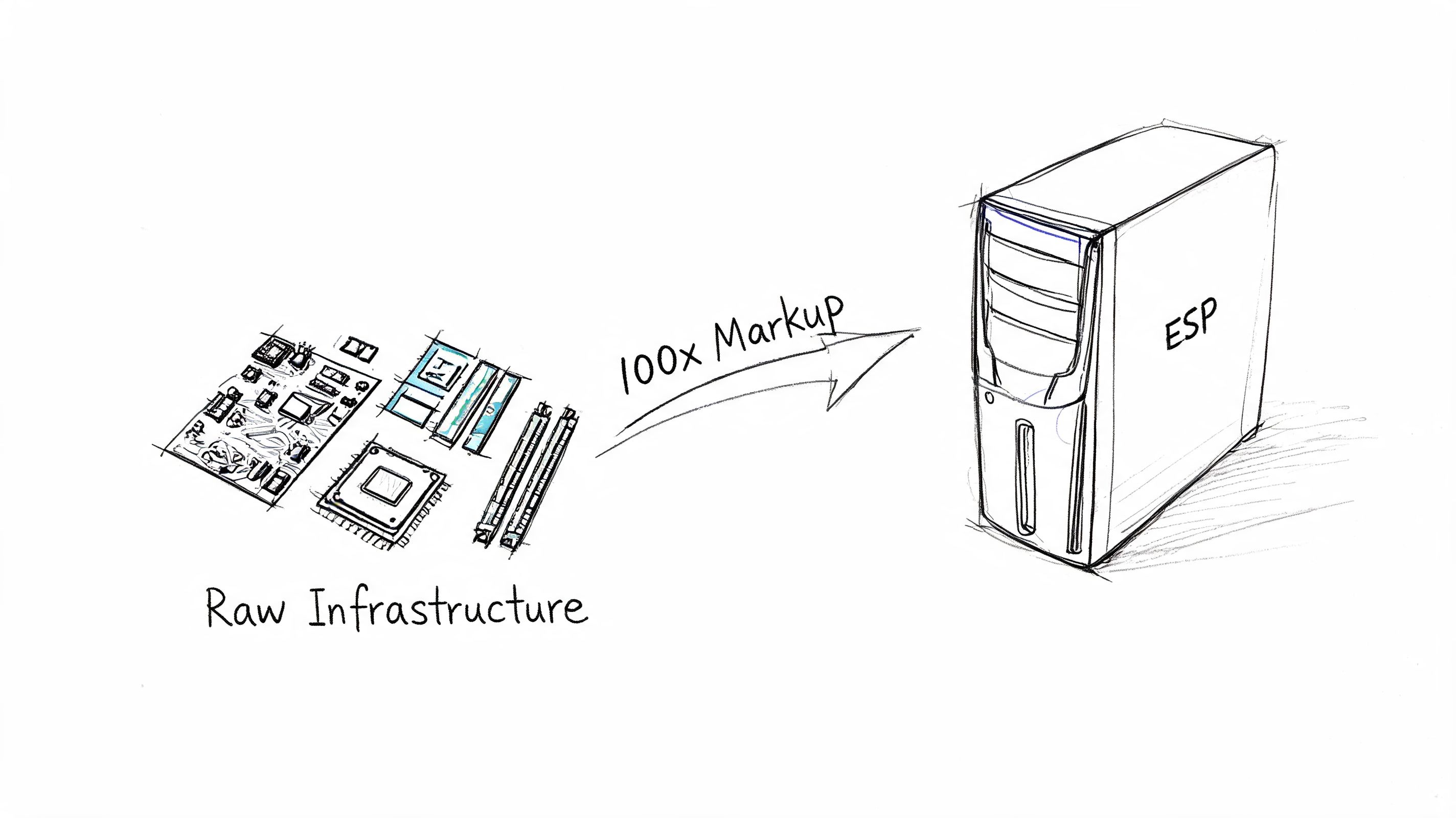
Traditional ESPs usually sell the bundle. You get the dashboard, templates, automations, reporting, support, and the sending rails underneath. That package is convenient, but convenience is where the margin hides. The underlying delivery cost reveals the truth.
Two very different cost structures
Raw infrastructure providers charge for actual sending volume. Amazon SES is the clearest example. Its pricing is based on emails sent, with very low per-message costs, as shown on the Amazon SES pricing page.
Traditional ESPs do not price that way. They commonly charge by subscriber tier, feature tier, or both. Your bill rises because your database grows, your automation count expands, or a higher plan gate opens up. It does not rise because the underlying cost to deliver each extra email suddenly became expensive.
That distinction matters more than many founders realize.
An ESP is not just reselling infrastructure at a modest premium. In many cases, it is applying a massive markup to cheap sending rails, then hiding that markup inside subscriber caps, feature bundles, and upgrade thresholds. That is the middleman tax.
Where the extra money goes
Some of the markup pays for real product value. Good software takes work to build and maintain. Teams may want visual builders, segmentation, A/B testing, managed warmup, compliance controls, and support.
The problem is that pricing often drifts far beyond the cost of providing those features. Once a brand depends on a vendor’s automations, forms, templates, and list model, switching becomes painful. That gives the vendor room to expand margin aggressively.
A practical way to evaluate this split is to compare infrastructure economics separately from application-layer pricing. This AWS SES vs SendGrid cost comparison helps frame that decision in plain terms.
Here is the bottom-line breakdown:
- Infrastructure providers charge for delivery volume.
- Traditional ESPs charge for software, packaging, and dependency.
- The spread between those two numbers is often what turns email into an overpriced line item.
That spread is not a law of nature. It is a business model. Savvy operators treat it that way and decide how much middleman margin they want to keep paying.
Anatomy of an Inflated Email Bill
The trick in ESP pricing is that the bill stops tracking delivery cost pretty early. Once a store reaches roughly 25,000 subscribers, the invoice starts reflecting packaging, thresholds, and vendor margin far more than the act of sending email.
That is why founders feel the number is off, even before they run the math.
At this stage, the platform usually is not charging in a way that maps cleanly to business value. It charges for list size, for crossing plan limits, and for access to bundled tools that may or may not matter to your team. A bigger database becomes a bigger bill, even if engagement is flat, suppressions are improving, and send volume is under control.
What the invoice is actually made of
A standard ESP bill often rolls several very different charges into one monthly number:
- Subscriber pricing. You pay for contacts stored in the platform, not just emails delivered.
- Plan thresholds. Crossing a contact cap pushes the account into a more expensive tier.
- Bundled software. Forms, popups, templates, reports, and automation get packaged together whether you use them heavily or not.
- Vendor margin. The platform builds in room for aggressive profit as your list grows.
Each line item scales differently. Sending costs typically rise with volume, while ESP revenue often increases alongside your dependency on the platform.
Why subscriber-based pricing gets expensive fast
Subscriber billing sounds reasonable until a business starts operating with discipline.
A well-run email program removes inactive contacts, segments buyers from prospects, and sends fewer low-value blasts. In theory, that should make email more efficient. In practice, many ESPs still keep charging off the top-line database number. The result is familiar. You improve list quality, but the invoice keeps climbing because growth pushed you into a higher tier months ago.
That is the shell game.
Here is how the bill usually breaks down in plain English:
| Bill Component | What the platform is really charging for |
|---|---|
| Subscriber tier | Database size |
| Monthly platform fee | Access to the software layer |
| Forced upgrade | Crossing a plan threshold |
| Add-on pressure | Convenience sold as a package |
The mismatch founders eventually notice
The frustrating part is not that software costs money. Good software should cost money. The problem is the spread.
As noted earlier, raw sending infrastructure can be extremely cheap. The inflated bill comes from putting that cheap rail inside a pricing model designed to skim more revenue as your audience grows. That is why email can look like a normal SaaS expense on paper while acting like a tax on list growth underneath.
A bloated ESP invoice usually isn’t a usage bill. It’s a bill based on vendor control.
Once you see the invoice this way, the pattern becomes obvious. You are paying for delivery, software, convenience, and a large middleman markup in one blended number. That blend is what hides the actual cost.
The True Price of Shared IP Pools and Vendor Lock-In
The expensive part of many ESPs is not the software. It’s the loss of control hidden inside the bundle.
Many traditional ESPs put customers on shared IP pools, which means your sender reputation is tied to companies you did not choose and cannot police. If another account on that pool sends junk, buys lists, or spikes complaints, your deliverability can sink with theirs.
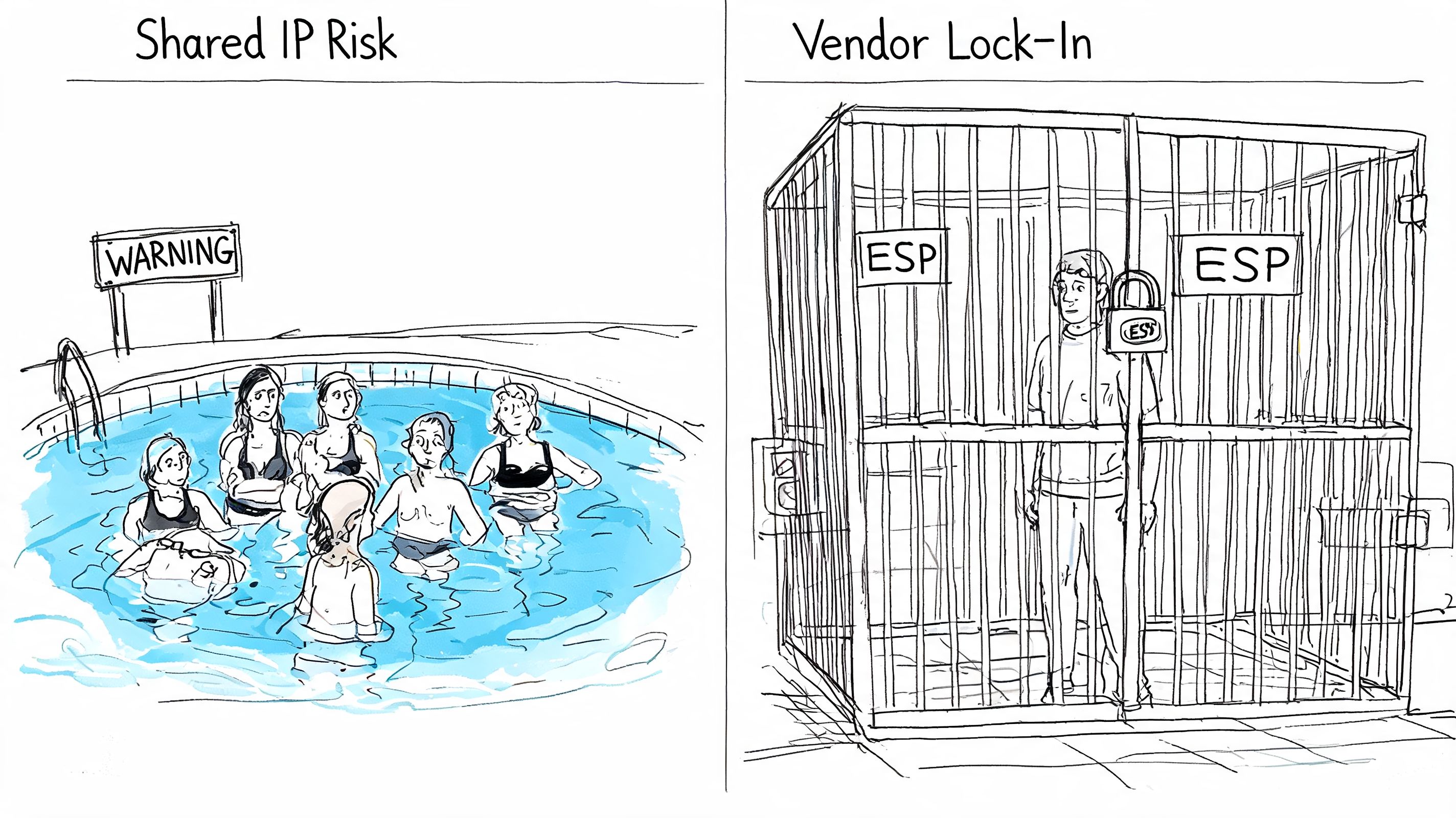
Shared infrastructure creates shared risk
That trade-off gets glossed over because the interface looks polished and the monthly fee looks familiar. Under the hood, you are still paying a heavy middleman markup for low-cost sending infrastructure, then accepting delivery risk created by other tenants in the same environment.
Analysts in this 2026 pricing guide describe the pattern clearly. Platforms can charge hundreds per month at moderate list sizes because they bundle features, shared sending environments, and margin on top of cheap infrastructure. The same guide notes higher complaint rates on shared IP setups, throttling risk once spam complaints climb too high, and materially better inbox placement on dedicated setups with proper authentication and warmup.
That hits revenue fast.
If your campaign underperforms because of copy, that’s fixable. If it underperforms because your ESP grouped you with careless senders, you are paying premium software prices for someone else’s bad behavior.
The hidden deliverability tax
Shared pools create a cost that never appears as a line item on the invoice. Lower placement, slower delivery, and noisier performance make the channel less reliable, which pushes teams to over-send, discount harder, or accept weaker returns as “normal.”
I’ve seen this play out the same way more than once. A founder assumes the list is getting tired, the offer is off, or the market changed. Then they move to a setup with dedicated reputation control and the same audience starts responding again. The problem was not email as a channel. The problem was rented infrastructure with pooled risk.
A few warning signs usually show up before teams identify the underlying cause:
- Campaign swings that make no sense. Similar emails produce very different results without a clear segmentation or creative explanation.
- Delivery timing that feels inconsistent. One send arrives quickly, another dribbles out or gets throttled.
- Authentication and reputation limits. The platform gives partial visibility, partial control, and lots of vague reassurance.
- Support answers that sound generic. You hear “results vary” instead of getting direct access to the sending layer.
If you do not control sender reputation, you do not fully control email performance.
Vendor lock-in makes the problem expensive to fix
Shared IP risk would be easier to tolerate if leaving were easy. It usually isn’t.
Once your templates, automations, suppression logic, forms, reporting, and audience structure are all trapped inside one ESP, migration turns into a project nobody wants to touch. That friction protects the vendor’s markup. It keeps you paying software rates that are wildly disconnected from raw delivery cost, even after the platform starts limiting performance.
The practical answer is not that every company needs a complex deliverability operation from day one. The answer is simpler. Use a model that gives you direct control over the provider account, authentication records, and reputation setup, so switching software does not mean rebuilding the whole channel.
That is how you stop paying the middleman tax and start treating email like infrastructure you control, not a black box you rent.
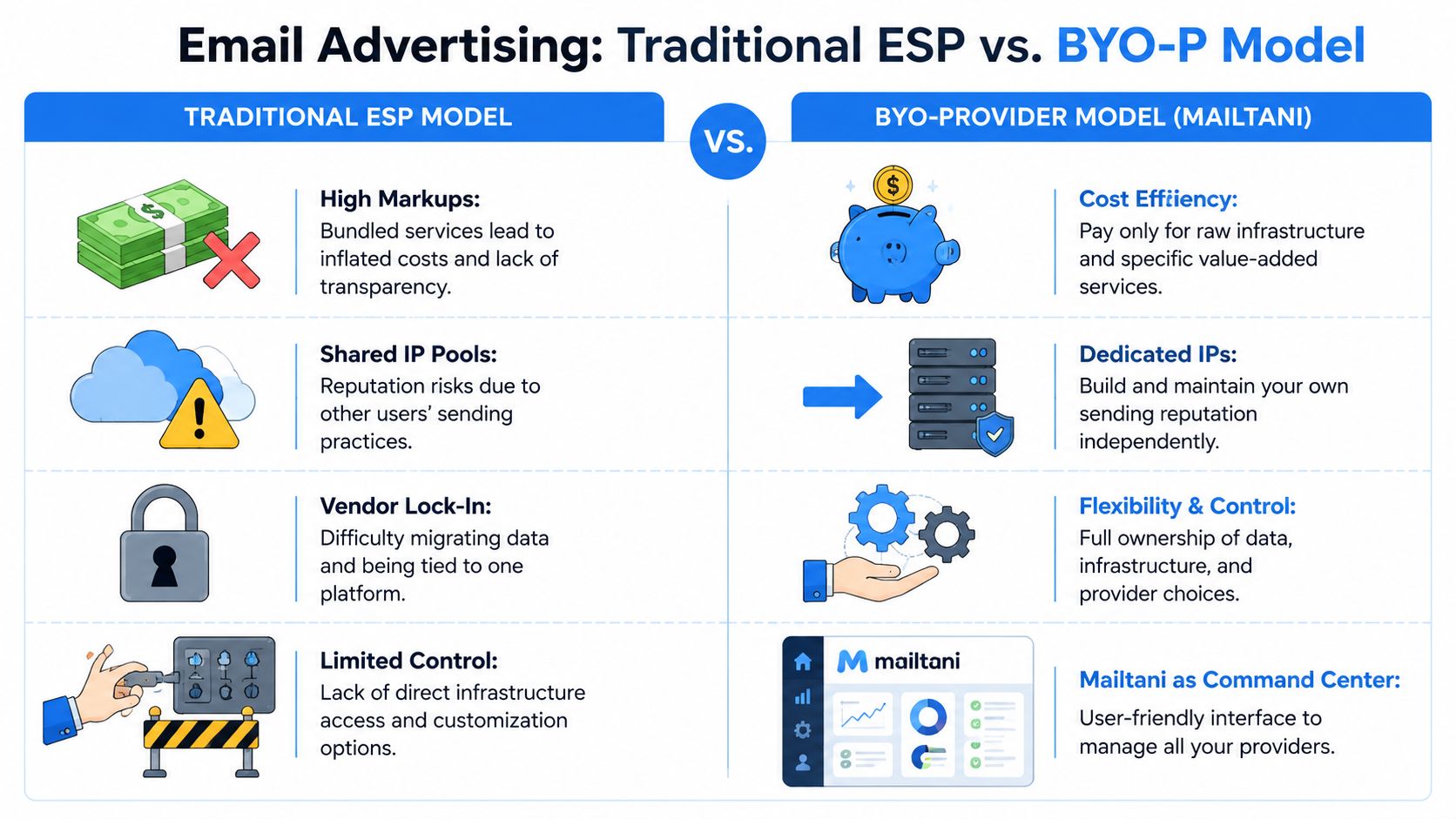
The BYO-Provider Model Taking Back Control
There’s a cleaner way to structure the stack. Keep the software layer. Separate it from the sending provider.
That model is often called Bring Your Own Provider. Instead of letting one vendor own the interface, the infrastructure, and the pricing power, you choose the provider account yourself and connect software on top of it.
What changes in practice
The big shift is conceptual. You stop renting the engine and start owning it.
A traditional ESP says, “Use our builder, our billing model, our sender environment, and our rules.” A BYO-provider setup says, “Use software you like, but connect your own provider such as Amazon SES, Resend, or Mailtrap.”
That changes the economics and the control surface at the same time.
- You pay the provider directly for actual sending.
- You keep flexibility if you ever want to change providers.
- You own more of your deliverability posture instead of inheriting whatever the shared pool gives you.
- You remove the subscriber-tier tax that makes growth feel punitive.
Why non-technical teams can still use it
This model sounds developer-heavy until you see the modern tooling around it. The software layer can still handle campaign creation, automations, segmentation, analytics, forms, and reply management. The difference is that the software doesn’t need to hide the infrastructure from you to be useful.
Here’s a quick walkthrough that shows the idea in action:
That’s why this approach matters for founders and operators, not just engineers. You don’t need to become a deliverability specialist. You need a stack that stops charging like a gatekeeper.
Side-by-Side Showdown Traditional ESP vs Mailtani + SES
The cleanest way to judge email advertising cost is to price the same operation two ways. First, as a standard ESP customer buying bundled software and sending. Second, as a business that buys the software layer separately and pays the mail provider directly.
That comparison exposes the shell game.
A traditional ESP wraps cheap infrastructure in subscriber tiers, feature gates, and recurring rent. Direct infrastructure pricing stays much closer to actual usage. Amazon SES publishes its sending rates openly on its pricing page. That matters because it gives you a visible baseline before any software markup gets layered on top.
Cost Comparison Traditional ESP vs. Mailtani + Amazon SES 25k Subscribers
| Cost Component | Typical ESP | Mailtani + Amazon SES |
|---|---|---|
| Annual platform and tier cost at 25k subscribers | Often priced as a recurring subscriber plan | One-time software purchase plus direct provider billing |
| Underlying send cost | Bundled and hard to isolate | Charged separately by Amazon SES at published rates |
| Pricing model | Monthly or annual rent tied to contact count | Software fee plus infrastructure cost tied to sending volume |
| Vendor dependency | High | Lower, because provider access is controlled directly |
For the software side, the current Mailtani pricing shows the one-time structure directly.
What this comparison actually means
The core issue is not just paying more. It is paying a middleman tax that can be wildly out of proportion to the raw delivery cost underneath.
I do not object to paying for real software value. Good campaign tools, automations, analytics, and list management save time. The problem starts when the infrastructure itself is cheap, but the pricing model keeps climbing because your list grew. At that point, the bill is no longer tracking what email costs to send. It is tracking how much pricing power the platform has over a captive customer.
Founders usually do not mind paying for a competitive advantage. They mind paying recurring rent on top of commodity infrastructure with massive markup.
That is why this side-by-side matters. It turns an abstract software bill into a buying decision. Keep renting the whole stack from a platform that hides the underlying math, or separate the software from the sending layer and keep more of the margin.
From Cost Center to Strategic Asset The Case for Owning Your Email Stack
A common mistake is treating email like a fixed overhead line item. For a healthy business, email is a margin engine. If you keep paying ESP pricing that sits far above raw delivery cost, you let a middleman skim profit from one of your best-performing channels.
Earlier data in this article showed why email keeps earning budget. Strong programs can produce serious returns, even before you strip out inflated platform fees. That is exactly why pricing matters so much. If the channel already works, reducing the markup improves the economics immediately.
The strategic question founders should ask
A better question is simple. Who should keep the spread between commodity infrastructure cost and what your current platform charges you?
Owning your email stack changes the answer. Instead of renting access to sending infrastructure through a vendor that controls the account, the pricing, and often the migration pain, you control the provider relationship directly. That shifts email from a recurring expense you tolerate into an asset you manage.
I have seen founders accept high ESP bills because the software feels bundled, familiar, and hard to replace. That comfort gets expensive. Once your list grows, the software fee often has less to do with delivery cost and more to do with how hard it is for you to leave.
What ownership actually buys you
Owning more of the stack creates practical business advantages:
- More retained margin. Less money disappears into markup, so each campaign keeps more of the revenue it generates.
- Direct infrastructure control. Your sending setup, reputation work, and provider access stay in your hands.
- Lower switching risk. If you need to change software or providers later, the move is operational, not existential.
- Better budgeting. Costs track actual sending volume and software value more closely than subscriber-tier rent.
Those trade-offs matter. A fully managed ESP can still make sense for teams that want maximum hand-holding and are willing to pay for it. But many businesses are not buying premium strategy or premium deliverability. They are paying premium prices on top of cheap underlying infrastructure.
That is the shell game.
Amazon SES pricing is public. The raw send cost is low. Yet businesses often end up paying many multiples above that through standard ESP plans, and in some cases the markup is closer to 100x than 10x once list-based pricing kicks in. The minute you separate software from infrastructure, the math gets harder for the middleman to hide.
Email becomes more valuable when you own the sending rails, the provider relationship, and the economics.
There is also a control advantage that does not show up neatly on an invoice. If a vendor changes policy, tightens account rules, or pushes another price increase, your email program should not be trapped inside their business model. Ownership gives you room to adapt without rebuilding the channel from scratch.
Email should be treated like an asset you operate. You protect sender reputation, keep the provider relationship direct, and stop paying recurring markups on a commodity layer.
If you’re done paying a middleman tax on every send, take a look at Mailtani. It gives you the email marketing layer you need while letting you bring your own provider, keep your costs tied to real infrastructure, and avoid the subscriber-tier pricing trap that makes email more expensive than it needs to be.


