
Can You Text an Email: 4 Simple Methods Explained
Can you text an email - Yes, you can text an email. Learn the 4 main methods, from simple carrier gateways to scalable SMS APIs, and discover the best approach

On this page
You’re usually asking “can you text an email” because one channel just failed you.
A customer hasn’t seen an order issue. A lead ignored a follow-up. A login alert is sitting unread in an inbox while the clock keeps moving. At that moment, the hack sounds simple: send the message as a text instead.
Yes, you can text an email. But the answer matters less than the method. The quick workaround that’s fine for one personal message can become a deliverability mess, a reply-handling nightmare, or a compliance problem once you use it for real business communication.
Most guides fall short. They show the trick. They don’t show the trade-offs. For merchants, SaaS teams, and developers, that’s the whole story.
Why Texting an Email is More Than a Curiosity
A flash sale is a good example. Email can carry the creative, the branding, and the longer message. But if the offer expires soon, waiting on inbox behavior is risky. Business texting behaves very differently. Business text messages achieve a 98% open rate and 96% are read within 3 minutes, while email averages a 20% open rate, according to Kenect’s business texting data.
That’s why the question matters. Not because texting an email is clever, but because channel choice changes outcomes when timing matters.
The business use case is usually urgency
Teams reach for email-to-text in a few common situations:
- Time-sensitive alerts like account verification, fraud warnings, delivery issues, or appointment changes
- Operational updates when a staff member won’t be sitting in front of an inbox
- Fallback delivery when email is the system of record but SMS is the attention layer
- Two-step outreach where email holds the detail and text nudges the recipient to check it
Practical rule: Use SMS for urgency and email for depth. Problems start when you expect one message format to do both jobs well.
The decision isn’t whether you can send a text to an email address or route email into SMS. It’s whether you’re doing a one-off shortcut or building a communication path your business can trust.
Cheap tricks and real systems are not the same
The free route usually means a carrier gateway. It feels direct because it is direct. It also gives you very little visibility, little control over formatting, and weak reply handling.
The professional route usually means an API-based workflow. It takes more setup, but you gain logs, validation, cleaner routing, and a system you can evolve. If you’re sending anything customer-facing at scale, those differences stop being technical details and become operating costs.
How Your Phone Carrier Translates Text to Email
The first encounter with email-to-text is often through a carrier gateway. It looks odd, but the idea is simple. The mobile carrier acts like a translator between messaging systems.
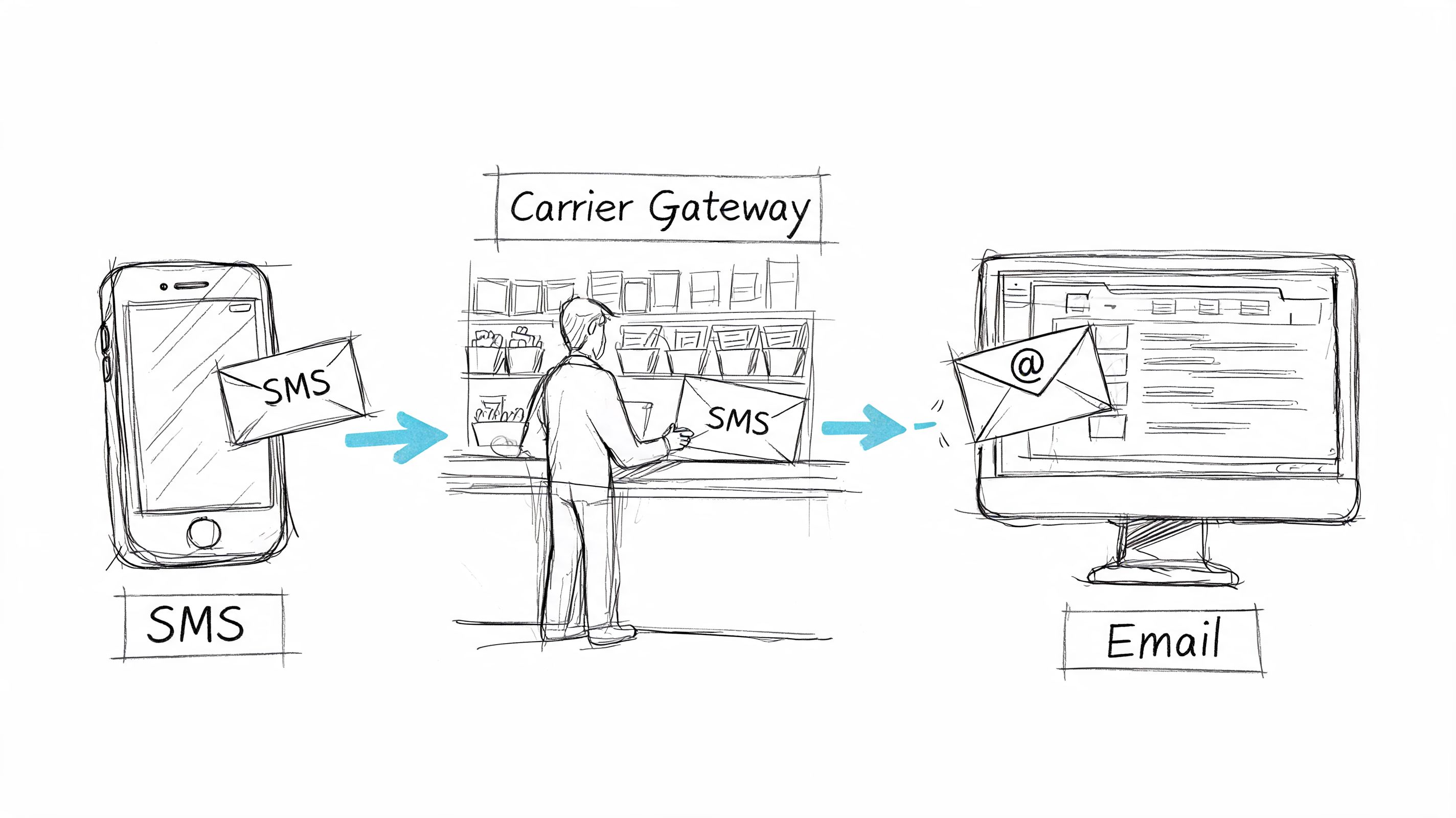
Carrier-specific SMS-to-email gateways let you text an email address by routing the message through a domain managed by the mobile operator, which converts the short SMS payload into email using carrier infrastructure and protocols like SS7, as described in Vida’s explanation of SMS-to-email gateways.
What actually happens
Think of the carrier gateway as a mailroom clerk.
You send a message to a specially formatted destination. The carrier receives it, recognizes that the destination should be transformed, then repackages it for the other system. A text becomes an email, or an email becomes a text, depending on the direction.
In plain terms, the process looks like this:
- The message reaches the carrier gateway
- The gateway parses the sender, recipient, and body
- The carrier reformats the content for the destination channel
- The recipient gets a simplified version of the original message
That’s why these messages often lose polish. SMS and email weren’t built to preserve the same structure.
Why it feels easy and why it isn't
For personal use, carrier gateways can be convenient. You don’t need to build anything. You don’t need a developer. If you know the right carrier domain, you can try it in minutes.
The catch is that gateways are old infrastructure. They were never designed to be a polished business messaging layer with reporting, routing logic, and lifecycle tracking. They’re translators, not campaign systems.
A carrier gateway is good at moving a short message from one format to another. It’s not good at behaving like a customer communications platform.
Attachments are another friction point. Some gateways strip them. Others convert them poorly. Long bodies get clipped, reformatted, or delivered in a way that feels broken to the recipient.
If you work with telephony or messaging infrastructure, this translation model will feel familiar. Resources on GSM gateways for VoIP in Dubai are useful because they show the same broader pattern: gateway systems bridge networks, but every bridge introduces constraints, carrier rules, and control points you don’t own.
Comparing Your Four Main Sending Options
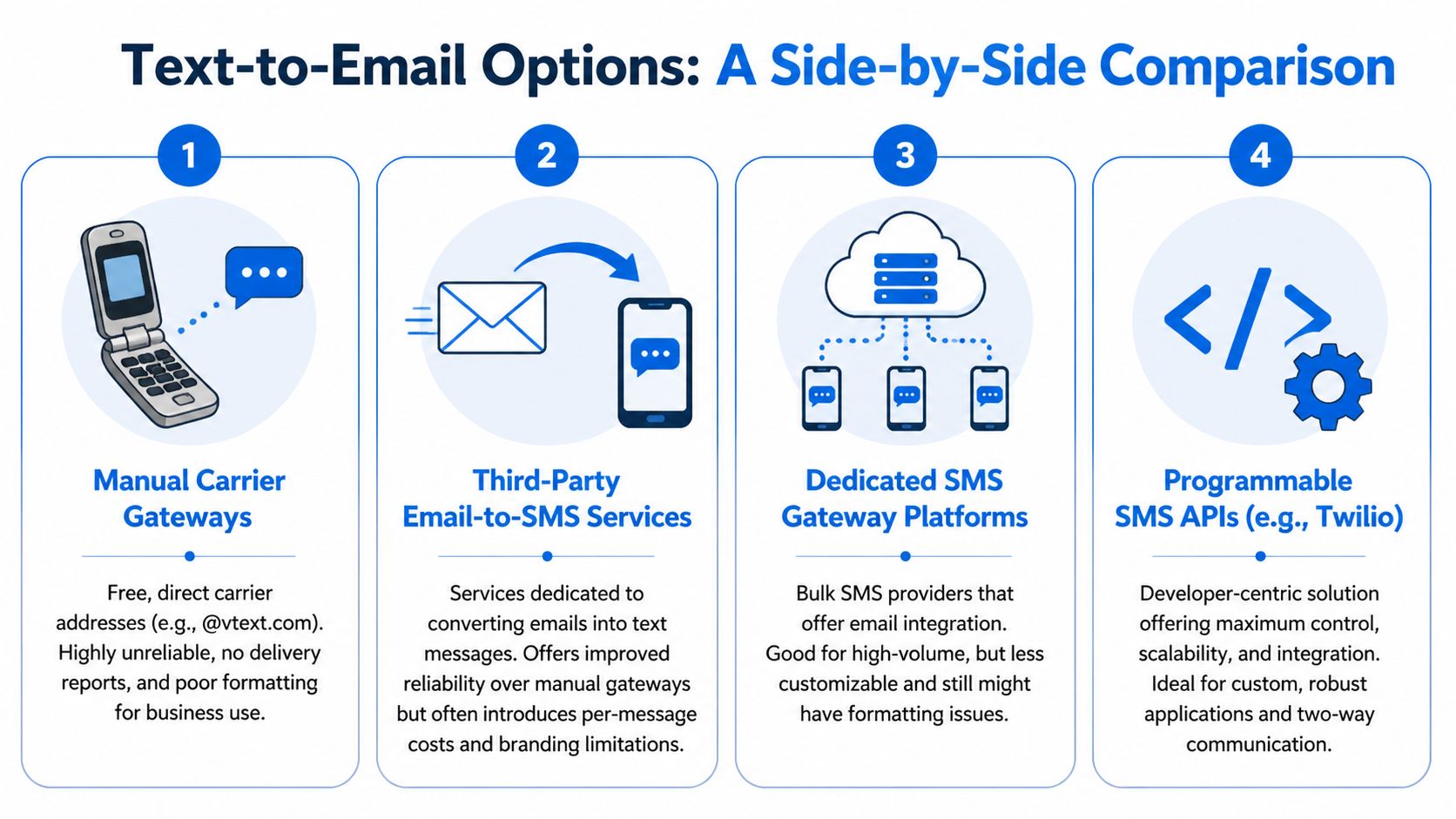
If you’re deciding how to text an email for business use, there are four main paths. They don’t compete on the same level. Some are hacks. Some are proper systems.
At a market level, the volume difference matters. An estimated 376.4 billion emails are sent and received daily worldwide, which is why email remains the base communication layer for most businesses, and why cost control matters when you scale sending infrastructure, as noted in Porch Group Media’s email statistics roundup.
Manual carrier gateways
This is the quick-and-dirty method. You send to a carrier-formatted address and hope the message arrives in a readable way.
Best use: one-off internal messages, testing, personal use.
Worst use: customer notifications, marketing, or anything that needs reliable reply handling.
Forwarding services and hosted bridges
Some services sit in the middle and convert emails into texts for you. They’re easier than building an API workflow, and often cleaner than manual gateways.
They’re useful when a team wants convenience, but they often add branding limitations, another vendor in the chain, and another place where failures can happen.
SMS platforms and programmable APIs
The rationale for business use becomes clear. A dedicated SMS provider gives you an explicit sending layer, and a programmable API lets you define how email content becomes a text message.
That means you can validate sender inputs, rewrite content, map replies, and log everything.
For a broader look at bridging email and text for business, it helps to compare where simple forwarding ends and real messaging workflow design begins.
Direct integration patterns
This is the developer-minded approach. Your app or automation receives an email event, decides whether SMS is appropriate, transforms the message, and sends through your chosen providers.
That architecture gives the most control over cost, deliverability, and portability. It also makes provider changes less painful because the business logic belongs to you.
For teams evaluating infrastructure choices, a curated email providers list is useful because your provider setup affects how much control you retain.
Email-to-Text Methods Comparison
| Method | Cost | Scalability | Reliability | Two-Way Replies |
|---|---|---|---|---|
| Manual carrier gateways | Low upfront, but hidden operational cost | Poor | Fragile | Weak |
| Third-party forwarding services | Ongoing vendor cost | Moderate | Better than manual gateways | Limited to service design |
| Dedicated SMS gateway platforms | Usage-based and more predictable | Strong | Good | Usually supported |
| Programmable SMS APIs with direct integration | Build cost plus provider usage | Strongest | Best control | Best control |
A simple rule helps here. If a human can manage the entire flow manually, a gateway may be enough. If a business process depends on it, use a system that exposes logs, routing, and reply state.
The Hidden Problems with Texting Emails
The free methods look attractive because they hide failure until after you send.
Carrier gateways and improvised forwarding setups can work just well enough to lure teams into using them for customer-facing communication. That’s usually when the weak points show up.
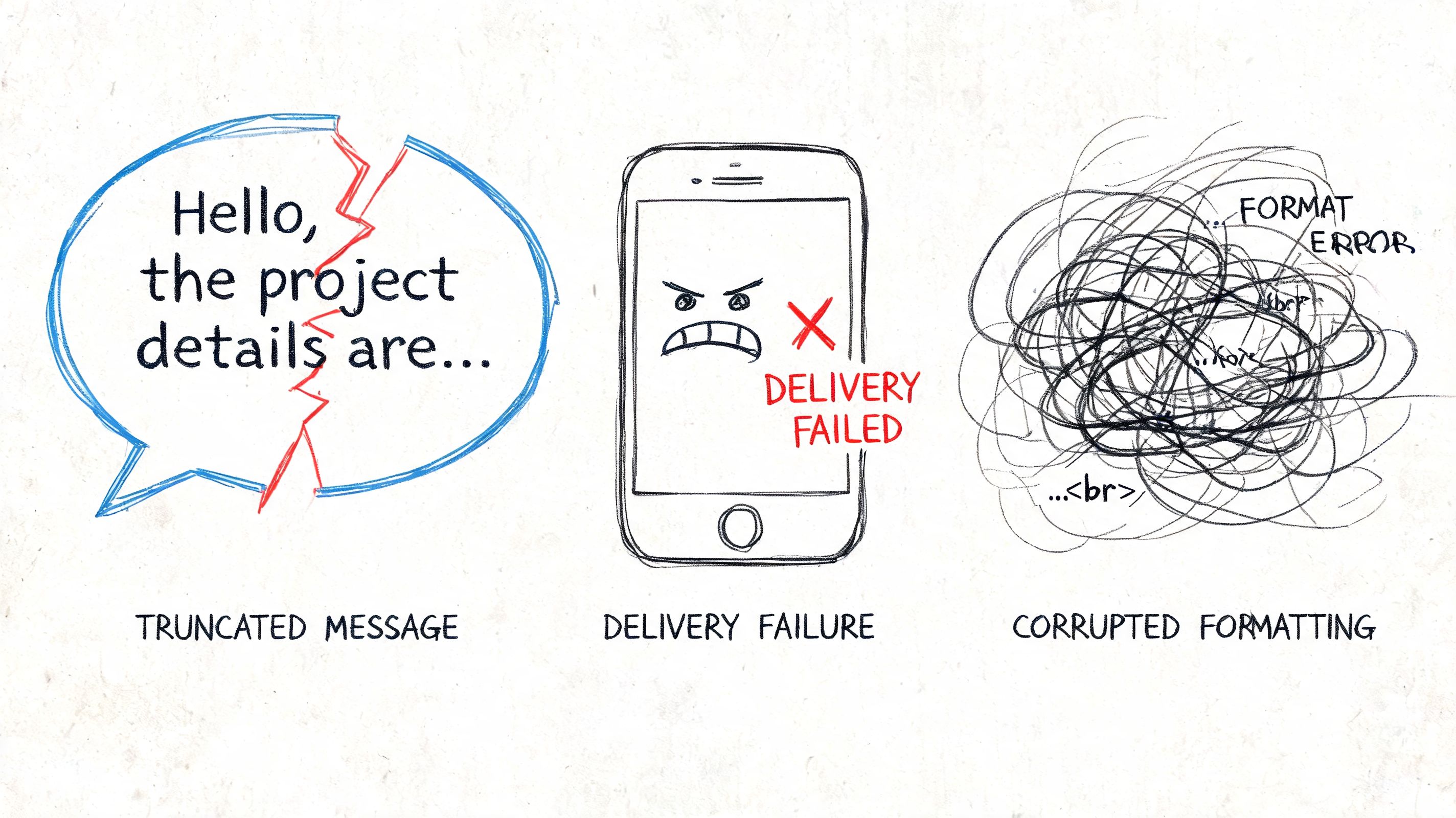
Formatting breaks first
Email content is structured for inboxes. SMS is not. Subject lines, signatures, links, footers, and multipart content become clutter when squeezed into a text workflow.
What works poorly:
- Long bodies that assume scrolling, spacing, and visual hierarchy
- HTML-heavy templates with tracking elements and formatting baggage
- Attachment-dependent messages where the file matters as much as the text
- Multi-recipient logic because texts are usually much more linear
Teams underestimate the cost of “free.” The message technically sends, but the recipient gets something confusing.
If the recipient has to decode the message format, delivery didn’t solve the problem.
Replies create operational debt
Reply handling is where most email-to-text shortcuts fall apart. The sender assumes replies will route cleanly. In practice, they may land in the wrong inbox, show up without context, or fail to map back to the original thread.
That creates three problems fast:
- Support confusion because agents can’t tell which message triggered the reply
- Broken automation when a system can send but can’t reliably ingest responses
- Scattered records across inboxes, tools, and carrier behavior you don’t control
This is one reason serious teams invest in centralized deliverability and reply visibility instead of treating messaging like a forwarding trick. If you care about inbox placement and message control on the email side, a dedicated email deliverability workflow becomes part of the same operational discipline.
Compliance gets ignored until it hurts
The biggest blind spot isn’t technical. It’s legal and operational.
A major issue with gateway-based emailing and texting is HIPAA and GDPR risk. If a business casually pushes sensitive information through SMS-email workflows, exposed data and scattered replies can create serious compliance problems, especially because carriers may retain messages and the conversation trail becomes fragmented, as discussed in Holland & Hart’s guidance on emailing and texting PHI.
That changes the answer to “can you text an email” for healthcare, finance, and account-security use cases. The question becomes: should this specific message ever pass through that path?
For regulated communication, “it usually works” isn’t a standard. You need consent handling, retention logic, access control, and a clear record of what was sent through which channel.
Building a Scalable Email-to-SMS System
If the workflow matters, build around events and APIs instead of gateways.
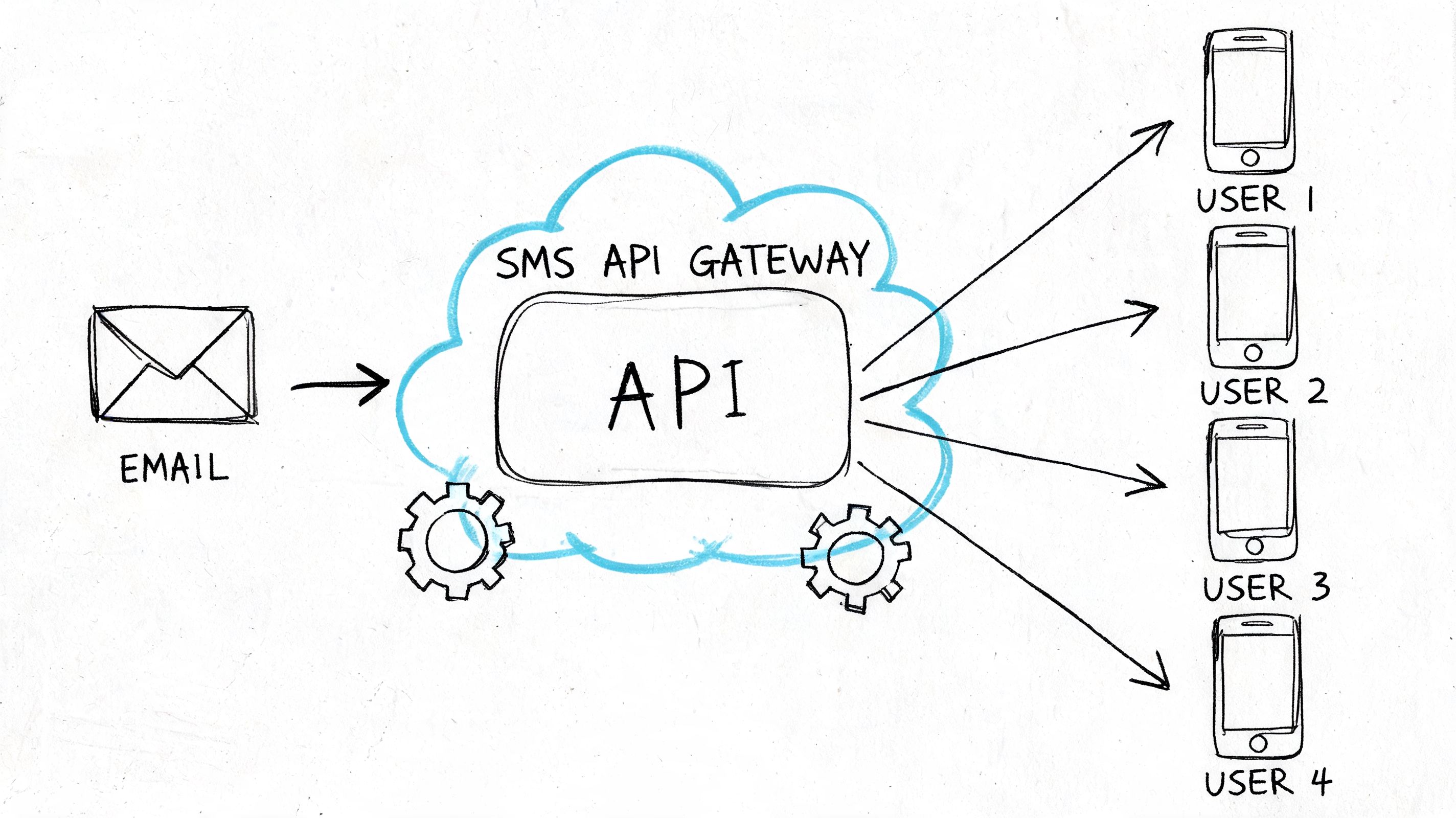
The clean model is simple: email remains one system, SMS remains another, and your application decides when to bridge them. That keeps the channels separate while giving you control over formatting, logging, and reply routing.
A practical architecture
A scalable setup usually includes these parts:
- An inbound trigger from your email system, app event, or support tool
- A transformation layer that strips the message down to SMS-safe content
- An SMS API provider that handles delivery and status callbacks
- A reply router that sends responses back into the right inbox, CRM, or app record
- A queue so temporary provider issues don’t block the whole workflow
If you’re designing for reliability, queueing matters. A solid explainer like Pratt Solutions' message queue guide is helpful because message queues are what keep bursts, retries, and asynchronous delivery from turning into dropped notifications.
What a minimal workflow looks like
Here’s the conceptual version:
- A customer action creates an email event.
- Your app checks whether the message is urgent enough for SMS.
- A function rewrites the email into plain, short text.
- The SMS API sends the message.
- Delivery status and replies come back through webhooks.
- Your system stores the interaction against the customer record.
That model avoids a lot of the pain that gateway methods create. You decide which emails become texts. You control the output. You know what happened after send.
A bare-bones pseudocode flow looks like this:
on email_event:
  if message_type is urgent and recipient has sms_consent:
    sms_body = summarize(email_subject, email_body)
    send_sms(recipient_phone, sms_body)
    log_delivery(message_id, recipient_phone)
The key isn’t the code. It’s ownership of the logic.
Engineering rule: Don’t convert every email into a text. Convert specific events into purpose-built SMS messages.
For the email side, keep your sending stack modular. A provider-agnostic setup with stable SMTP integration options gives teams flexibility when they need to change providers, isolate workflows, or separate transactional mail from other streams.
That’s the business advantage of the API-driven route. Better control usually means lower long-term waste, cleaner debugging, and fewer surprises when volume grows.
When to Use Each Email-to-Text Method
The right answer depends on what you’re sending, how often you’re sending it, and what happens if the message fails.
The fast decision guide
Use a manual carrier gateway when you’re sending a one-off message and failure won’t create work for anyone else. Internal tests. Personal use. Occasional convenience.
Choose a forwarding service when you need a simple bridge and your workflow is still light enough that another vendor layer won’t slow the team down too much.
Use a dedicated SMS platform when you have repeatable business notifications and need cleaner sending, basic reporting, and more predictable operations than ad hoc gateways can provide.
Build around a programmable API workflow when the communication path is part of your product, store, support operation, or account lifecycle. That’s the point where logging, routing, consent, and reply mapping stop being optional.
One extra filter before you send
There’s another factor that most “can you text an email” articles ignore. Accessibility.
Existing guides often miss the needs of rural users who depend on SMS as a universal channel and users with disabilities who need clearer, more compatible message formats, which makes accessible plain-text design part of the decision, as noted in Clickatell’s discussion of messaging in underserved communities.
That changes how you write the message itself:
- Keep it plain-text first so meaning survives translation between systems
- Put the key action early because formatting may collapse
- Avoid vague references like “see below” or “open the attachment”
- Write for assistive tech and low-bandwidth contexts instead of assuming a polished smartphone experience
If you’re still deciding, use this shortcut. The less business-critical the message is, the more you can tolerate a shortcut. The more critical it is, the more you should own the infrastructure, the logic, and the reply path.
If you want the cost control of using your own email infrastructure without the usual ESP markup, Mailtani is worth a look. It lets you connect providers like Amazon SES, Resend, or Mailtrap, keep control of your sending setup, and manage campaigns, replies, and automations without getting locked into per-subscriber pricing.