
How to Write a Formal Email: Structure, Examples & Templates
How to write a formal email: the 7-part structure, how to start and end it, and 8 copy-ready templates for applications, inquiries, complaints, follow-ups and more.
On this page
TL;DR: A formal email follows seven parts in order: a specific subject line, a respectful salutation ("Dear Ms. Chen,"), an opening line that says why you're writing, a focused body, one clear call to action, a closing and sign-off ("Best regards,"), and a signature with your name, role and contact details. Keep it short, polite and about one topic. Copy-ready templates are below.
You're probably staring at a draft that feels too stiff, too vague, or too risky to send. Writing a formal email isn't about fancy language. It's about being clear, respectful and easy to say yes to. This guide covers the structure, how to write each part, and eight templates you can copy.
What Is a Formal Email?
A formal email is a professional message written for someone you don't know well, someone senior to you, or any situation with something at stake: a job application, a business inquiry, a complaint, a request to a client or an official body. It uses a proper greeting and sign-off, complete sentences, a neutral and polite tone, and no slang or emoji.
Use a formal email when:
- It's the first contact with a person, company or institution
- The recipient is senior to you or the relationship is new
- Something is at stake: money, a job, a complaint, a contract or a decision
- It may be forwarded or kept on record
Once the other person replies in a more relaxed tone, you can usually relax a little too.
Formal Email Structure
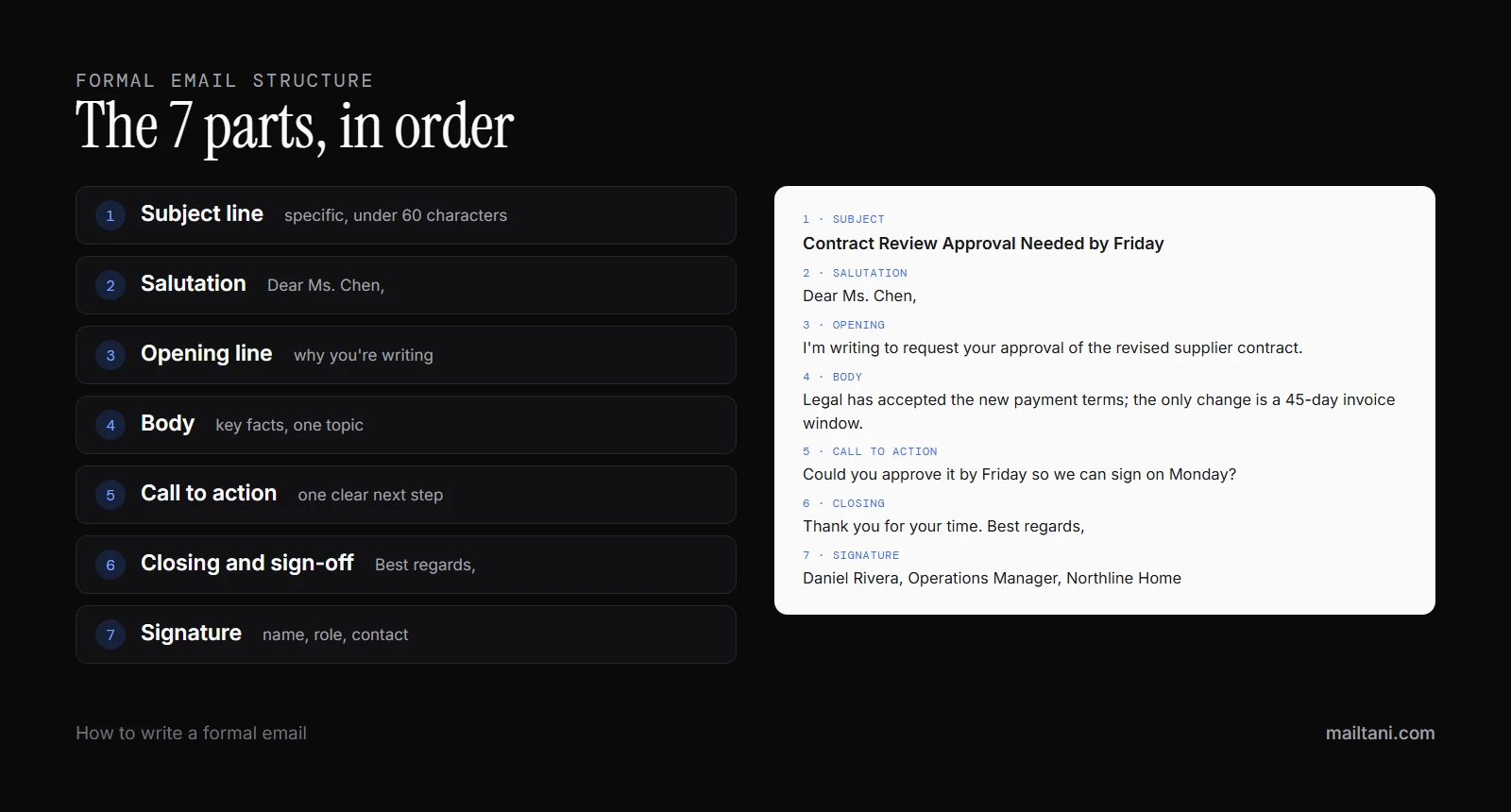
Every formal email follows the same order. The correct structure is: subject line → salutation → opening line → body → call to action → closing and sign-off → signature (sender details).
- Subject line: specific and under about 60 characters, so it isn't cut off on phones. "Contract Review Approval Needed by Friday" beats "Quick question".
- Salutation: "Dear Ms. Chen," for a first or senior contact, "Hello Priya," for a peer. "Dear Hiring Manager," when you don't know the name.
- Opening line: say why you're writing in the first sentence.
- Body: the key facts, one topic per email, in short paragraphs.
- Call to action: one clear next step, ideally with a time frame.
- Closing and sign-off: a short closing line, then "Best regards," "Kind regards," or "Sincerely,".
- Signature: full name, role, company and contact details.
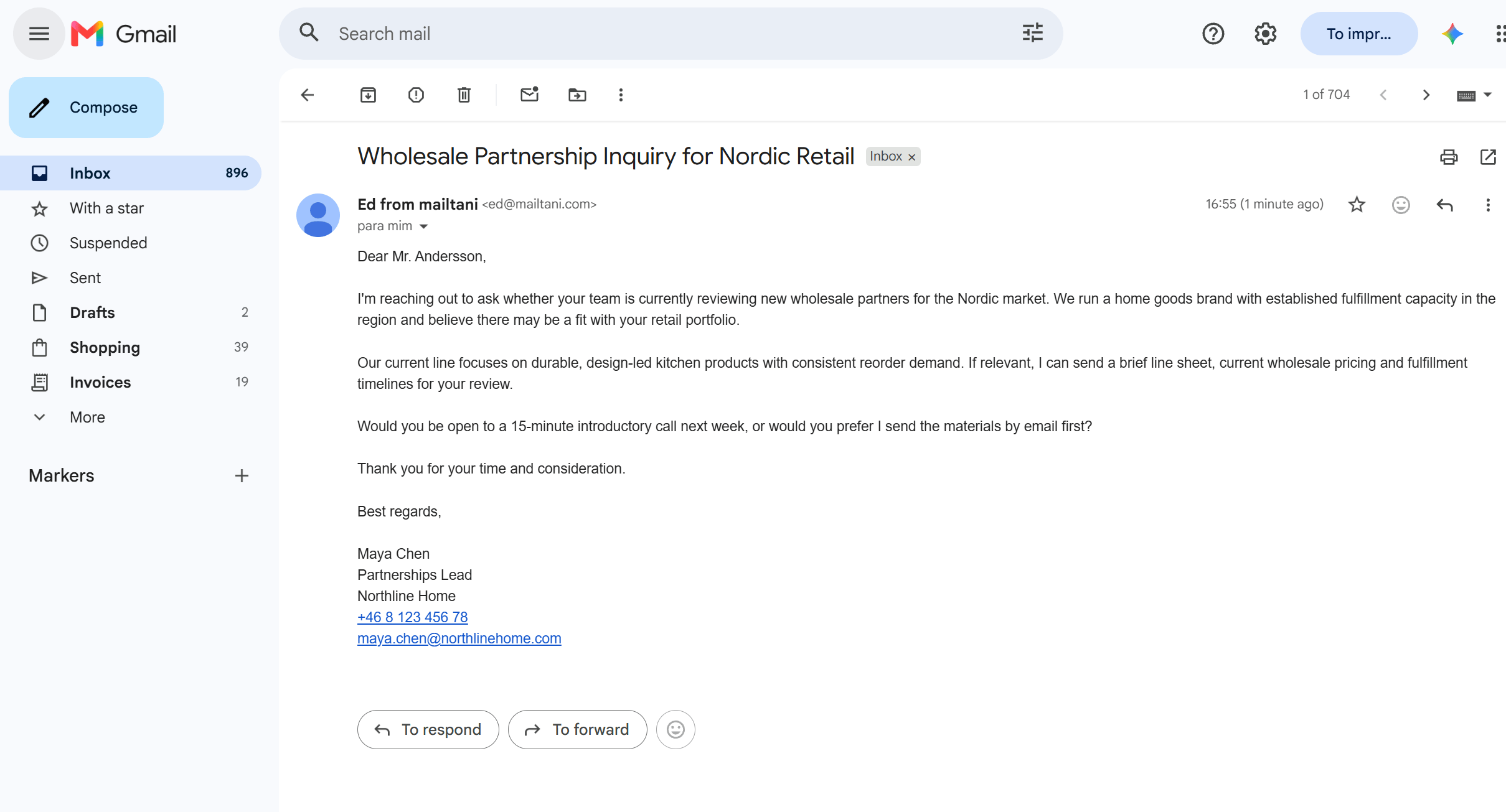
Here's what that looks like when it lands in an inbox:
Why Mastering Formal Emails Matters in 2026
Formal email still decides first impressions, approvals, partnerships, interviews, and customer outcomes. That matters more, not less, when inboxes are crowded and attention is thin.
That’s why writing formal email isn’t about sounding fancy. It’s about helping the other person process your message quickly and trust that replying won’t waste their time.
Formality is now a business tool
Founders feel this when they email a prospective partner. Marketers feel it when they contact a vendor. Support teams feel it when a frustrated customer writes in and expects a credible answer. In each case, the email has to do three jobs at once:
- Signal competence so the recipient takes the message seriously
- Reduce friction so the next step feels obvious
- Protect tone so the relationship doesn’t cool before it starts
When those pieces are missing, the message often fails before the body even gets read.
Practical rule: A formal email should make the recipient’s decision easier, not just present information.
A lot of avoidable damage comes from small habits. Weak subject lines, overlong openings, passive requests, and sloppy closings all create drag.
Precision beats polish-for-show
Old-school formal writing often overcorrected into stiffness. Modern professionalism works differently. It favors clarity, restraint, and useful warmth.
That means a formal email should be structured, respectful, and clean. It shouldn’t sound like a legal notice unless you’re writing one. The best business emails feel considered, not ceremonial.
The Anatomy of an Effective Formal Email
A formal email starts succeeding before the reader reaches the second line. Subject line, salutation, and opening sentence do most of the early work.
Write a subject line that earns the open
Most weak formal emails fail at the subject line because the sender tries to sound polite instead of useful. “Quick question,” “Checking in,” and “Following up” tell the recipient almost nothing.
The better approach is specificity: keep the subject under about 60 characters so it isn’t cut off on phones, and say exactly what the email is about. Our list of subject lines for follow-up emails shows more examples.
Good subject lines usually include one of these:
- A project name such as “Homepage Redesign Feedback Request”
- A decision point such as “Contract Review Approval Needed”
- A timeframe such as “Q4 Forecast Inputs by Friday”
- A clear business purpose such as “Wholesale Pricing Inquiry for EU Distribution”
If you want to pressure-test a subject before sending, a subject line tester can help catch vagueness and sharpen the promise.
Choose a salutation that fits the relationship
The greeting sets your level of distance. Get it wrong and the message feels either presumptuous or oddly rigid.
Use this quick guide:
| Situation | Best option | Avoid |
|---|---|---|
| First contact with a senior stakeholder | Dear Ms. Chen, | Hey Chen, |
| Professional contact with a peer | Hello Priya, | To Whom It May Concern |
| Unknown recipient in a hiring or support context | Dear Hiring Manager, or Hello Support Team, | Dear Sir/Madam |
| Ongoing thread with a familiar contact | Hi Marcus, if prior tone allows | Over-upgrading to Dear Mr. Lee mid-thread |
Modern formal email doesn’t require antique phrasing. It requires a greeting that shows respect without pretending you’re writing a printed letter in another century.
Open with purpose, not throat-clearing
The first sentence should tell the reader why the email exists. Not eventually. Immediately.
Weak opening:
- I hope you’re doing well and having a productive week.
- I just wanted to reach out and introduce myself.
- I’m writing this email to kindly ask whether it might be possible...
Stronger opening:
- I’m writing to request approval for the revised budget.
- I’m reaching out about your wholesale partnership inquiry.
- I’d like to confirm whether your team can deliver by Tuesday.
The opening line should lower the reader’s cognitive load. If they need to hunt for the point, the email is already underperforming.
Crafting a Clear and Persuasive Email Body
The body is where formal emails usually become messy. People add context that belongs later, stack multiple requests in one note, or write in a tone that sounds “professional” but reads like nobody talks that way.
The fix is simple. Put the most important point first, keep the body narrow, and make the ask unmistakable.
Lead with the point
Use the inverted pyramid. Start with the purpose, then the essential supporting detail, then the background only if the reader needs it.
That approach fits how people read email. They scan first. Then they decide whether the message deserves a full read.
A clean structure looks like this:
-
Purpose first
State the reason for the email in the first one or two sentences. -
Key facts next
Include only the context needed for the recipient to evaluate the request. -
Background last
Add extra detail only if it changes the decision or helps execution.
Here’s the difference in practice.
Weak:
I wanted to follow up on a few items from last week and also share some context on where we are with the launch timeline, since there have been a few moving parts internally and some feedback from the design team that may affect next steps.
Better:
I’m writing to confirm whether your team can approve the launch creative by Thursday. Design has finalized the revisions, and approval this week keeps the scheduled release on track.
Keep one message in one email
Formal emails get weaker as they try to do more. A pricing request, product update, timeline revision, and intro call proposal should not live in the same message unless they’re tightly connected.
Shorter emails with one clear request are easier to answer. That doesn’t mean every formal email must be tiny. It means every email needs a single center of gravity.
A useful body format is:
- Sentence 1: Why you’re writing
- Sentence 2 or 3: The minimum context
- Bullet list: If details need scanning
- Final line: One clear next step
If you’re worried your wording may trigger spam filters or sound overly promotional, a spam word checker is a practical final pass before you send.
Use a CTA the reader can act on immediately
The CTA is where many formal emails become passive. “Let me know your thoughts” is polite, but often too open-ended. It asks the recipient to define the task for you.
A stronger CTA gives the reader one action, one scope, and sometimes one time boundary.
Compare these:
| Weak CTA | Strong CTA |
|---|---|
| Let me know what you think. | Please reply by Friday with approval or requested edits. |
| Happy to discuss further. | If helpful, please send two times that work next week for a 15-minute call. |
| Looking forward to hearing from you. | Please confirm whether you’d like the proposal in monthly or annual pricing format. |
Operational advice: If the recipient can’t tell what a successful reply looks like, the email isn’t finished.
Closing with Professionalism and Purpose
A good closing does two things. It wraps the interaction neatly, and it reassures the reader that the sender is organized.
Many formal emails lose strength in the last three lines. The body is solid, then the ending turns vague, overly apologetic, or cluttered with a signature that reads like a mini brochure.
End the body with a clear transition
Before the sign-off, add a closing sentence that reinforces the purpose of the email without repeating the whole message.
Useful options include:
- Thank you for your time and consideration.
- I appreciate your review and look forward to your reply.
- Please let me know if you need any additional information.
- Thank you for helping us resolve this promptly.
These work because they close the body cleanly. They don’t introduce new requests or reopen the email.
Pick a sign-off that matches the situation
Sign-offs carry tone. The wrong one can feel stiff, overly familiar, or mismatched to the message.
Use this tier:
-
Sincerely,
Best for formal applications, official requests, and first-contact messages with more distance. -
Best regards,
The most versatile choice for business email. Professional without sounding ceremonial. -
Kind regards,
Slightly warmer. Good for partner communication, customer interactions, and relationship-led correspondence. -
Respectfully,
Best reserved for sensitive topics, complaints, or higher-formality institutional contexts.
Avoid sign-offs that undercut the message, such as “Cheers” in conservative settings or “Thanks!” when the email is a complaint or escalation.
Your signature should stay functional:
- Full name
- Role
- Company
- Relevant contact information
If you need a clean format, an email signature generator can help standardize it.
Treat proofreading as reputation control
Proofreading isn’t cosmetic. It’s the last step that protects trust.
Use a short final checklist:
- Names: Verify spelling, titles, and company names
- Ask: Make sure the CTA is singular and clear
- Tone: Remove anything defensive, passive-aggressive, or robotic
- Formatting: Break dense text into short paragraphs or bullets. Plain text is usually the safer format for one-to-one mail (see plain text vs HTML email)
- Attachments: Confirm they’re attached before entering the recipient address
A typo in a casual chat is forgettable. A typo in a formal business email changes how competent you look.
Formal Email Templates for Common Scenarios
Templates are useful only if they show judgment. A good formal email template isn’t a script to copy blindly. It’s a model for how to balance clarity, respect, and specificity.
Each template below is a starting point: keep the structure and change the details so they fit the person you're writing to. Use the copy buttons to grab the subject and body separately.
Job application email
Dear Hiring Manager,

I’m writing to apply for the Product Marketing Manager role listed on your careers page. My background in lifecycle messaging, product launches, and cross-functional campaign planning aligns closely with the responsibilities described in the posting.

In my current role, I work across product, design, and sales to turn feature releases into customer-facing campaigns with clear positioning and measurable follow-up. I’m especially interested in your team’s focus on simplifying adoption for technical products, which matches the work I’ve enjoyed most.

Please find my resume attached. I’d welcome the opportunity to discuss my application further.

Sincerely,
Elena Park
[Phone]
[Email]
Why this works:
- The subject is direct and searchable.
- The opening states the role immediately.
- The middle shows fit without pasting a resume into the email.
- The closing invites the next step without overreaching.
Business inquiry email
Hello Mr. Andersson,

I’m reaching out to ask whether your team is currently reviewing new wholesale partners for the Nordic market. We operate a DTC home goods brand with established fulfillment capacity in the region and believe there may be a fit with your retail portfolio.

Our current line focuses on durable, design-led kitchen products with consistent reorder demand. If relevant, I can send a brief line sheet, current wholesale pricing, and fulfillment timelines for review.

Would you be open to a short introductory call next week, or would you prefer I send the materials by email first?

Best regards,
Maya Chen
Partnerships Lead
Northline Home
[Phone]
[Email]
This one works because the email doesn’t oversell. It gives enough commercial context to establish relevance, then offers a simple branch for the next step.
Customer complaint email
Dear Customer Support Team,

I’m writing regarding order 18427, which arrived with visible damage to the outer packaging and one broken item inside. I’ve attached photos for reference.

I’d appreciate a resolution in the form of a replacement or refund. Please let me know which option you can offer and whether you need any additional information from me to process this request.

Thank you for your help.

Kind regards,
Daniel Rivera
[Phone]
[Email]
Why this works:
- It stays calm and specific
- It includes evidence without emotional sprawl
- It states the desired resolution clearly
- It leaves room for the company to solve the problem quickly
The best complaint emails don’t perform anger. They document the issue and make resolution easy.
Follow-up email
Dear Ms. Okafor,

I'm following up on the proposal I sent on 12 March for the Q3 onboarding project. I wanted to check whether you've had a chance to review it and whether any questions have come up.

If it would help, I'm happy to walk through the scope and timeline on a short call. Would Thursday or Friday afternoon suit you?

Kind regards,
Daniel Rivera
Operations Manager, Northline Home
[Phone]
[Email]
Chasing a survey response rather than a proposal? Use these survey reminder email templates.
Meeting request email
Dear Mr. Patel,

I'd like to request a 30-minute meeting to review the renewal terms of our supplier contract before it expires on 30 June.

The main points to discuss are the revised payment schedule and the delivery window for the autumn range. I can share a short summary beforehand.

Could you let me know two times that work for you next week?

Best regards,
Maya Chen
Partnerships Lead, Northline Home
[Phone]
[Email]
Request for information email
Dear Sales Team,

I'm writing to request pricing and lead times for bulk orders of your stainless steel cookware range.

We expect to order around 500 units per quarter, delivered to Stockholm. Could you share your price list for that volume, typical lead times and any minimum order requirements?

Thank you for your help.

Best regards,
Maya Chen
Partnerships Lead, Northline Home
[Phone]
[Email]
Thank-you email
Dear Ms. Lindqvist,

Thank you for meeting with me today to discuss the Product Marketing Manager role. I enjoyed learning about your team's plans for the European launch.

Our conversation confirmed my interest in the role, especially the focus on lifecycle messaging. Please let me know if you need anything else from me.

Kind regards,
Elena Park
[Phone]
[Email]
Apology email
Dear Mr. Rivera,

I'm sorry that your order 18427 arrived later than promised. A warehouse error delayed dispatch by three days, and we should have told you sooner.

We've refunded your shipping cost, and your next order will ship with priority handling. If anything else needs fixing, please reply to this email and I'll handle it personally.

Sincerely,
Sofia Berg
Customer Support Lead, Northline Home
[Phone]
[Email]
Navigating Cultural and Industry Nuances
The hardest part of writing formal email isn’t structure. It’s calibration.
A message that feels polished in a legal, finance, or procurement context may feel distant inside a startup, a creative agency, or a global product team. Strong professional communication depends on reading the room, even when the room is an inbox.
Adjust tone by context, not by habit
Industry matters. A law firm may expect full salutations, tighter courtesy language, and more explicit formality. A startup founder may prefer a brisk, direct style that still stays respectful. Neither is more professional by default. Each reflects a different working culture.
Relationship matters too. If someone signs off with their first name and writes short, direct replies, you can usually narrow the distance in your next message. If the interaction is new, sensitive, or high-stakes, it’s safer to start slightly more formal and relax later.
Avoid the over-formal trap
Over-formality can backfire: stiff, ceremonial phrasing reads as distant, especially in cultures and industries where directness is the norm.
That shows up in small phrasing choices:
- “As per my last email” often sounds irritated
- “Just wanted to resurface this” can feel firmer but less hostile
- “Dear Sir/Madam” may read as outdated or impersonal
- “Hello [Name]” is often the better neutral default
True professionalism isn’t rigidity. It’s knowing how to stay clear, respectful, and human across different audiences.
Formal Email FAQ
What is a formal email?
A formal email is a professional message for someone you don't know well, someone senior, or any situation with something at stake, such as a job application, business inquiry or complaint. It uses a proper greeting and sign-off, complete sentences, a polite neutral tone and no slang or emoji.
What is the correct structure of a formal email?
Subject line, salutation, opening line, body, call to action, closing and sign-off, then your signature with your name and contact details. In short: email topic, salutation, main message, formal closing, sender details.
How do you start a formal email?
Use "Dear" plus the person's title and surname ("Dear Ms. Chen,"), or "Dear Hiring Manager," if you don't know the name. Then state your purpose in the first sentence, for example "I'm writing to request…".
How do you end a formal email?
Add a short closing line such as "Thank you for your time and consideration." Then a sign-off like "Best regards," "Kind regards," or "Sincerely," followed by your full name, role and contact details.
How long should a formal email be?
As short as it can be while still giving the reader what they need to act: usually a few short paragraphs about one topic. If you need to cover several topics, send separate emails.
What is a good subject line for a formal email?
A specific one under about 60 characters that says what the email is about and, if relevant, what you need: for example "Contract Review Approval Needed by Friday" or "Application for Product Marketing Manager, Elena Park".
If email is central to how your business sells, supports customers, or runs outbound, mailtani gives you more control over the system behind those messages. You can send through your own provider, keep costs predictable, manage replies in one place, and build campaigns on infrastructure your business owns.