
How To Start a Newsletter: Grow Profitably
Learn how to start a newsletter profitably from day one. Our 2026 guide covers audience, content, setup, growth, cost control, and ownership.

Most advice on how to start a newsletter gets the first decision wrong. It tells you to pick a platform, choose a template, and start sending. That’s backwards.
A newsletter becomes valuable when it’s built like an asset, not a side project. The pertinent questions come earlier. Who is it for? Why would they keep opening it? And what happens to your margins when your list grows and your software bill grows faster? A lot of beginner guides talk about audience growth. Far fewer talk about infrastructure ownership, sender reputation, and the cost model that decides whether growth turns into profit or overhead.
If you're serious about learning how to start a newsletter, start there.
The Foundation Strategy Before Software
Most new newsletter operators think software is the foundation. It isn't. Software is a delivery mechanism. Strategy decides whether the thing deserves to exist.
That matters because a newsletter can look healthy on the surface and still be weak underneath. You can publish consistently, collect subscribers, and still build something fragile if you never defined the audience, the promise, or the economics. Existing guides spend plenty of time on audience-building tactics but often miss the infrastructure cost question that becomes critical as newsletters grow, especially for DTC brands and indie hackers, as noted in this analysis of newsletter blind spots.

Treat the newsletter like a product
A useful rule is simple. If you can't explain the newsletter in one sentence to one specific type of reader, you're not ready to send issue one.
A strong newsletter usually has three parts working together:
- A defined audience. Not "founders" or "marketers." More like Shopify operators with repeat purchase problems, or SaaS growth engineers dealing with deliverability issues.
- A clear value proposition. Not "insights and updates." Something tighter, such as weekly teardown emails on lifecycle flows, retention offers, or sending infrastructure choices.
- A sustainable economic model. You need to know whether this newsletter will sell products, support consulting, drive software signups, earn sponsorships, or become a paid publication later.
When people skip the third part, they often choose tools that feel easy at the start and expensive later. That's a strategic mistake, not just an ops mistake.
Practical rule: If every new subscriber makes your costs less predictable, your business model isn't finished yet.
Define the business before the cadence
A newsletter business isn't just "write every week." It needs operating constraints. How often can you publish without lowering quality? What kind of content can you produce repeatedly without burning out? What can you afford when your list scales?
Write down these answers before choosing any tool:
- Who you're serving
- What recurring problem you help solve
- What format you'll deliver consistently
- How the newsletter will create revenue or strategic advantage
- What level of control you want over sending infrastructure and costs
That last point gets ignored too often. If your platform pricing jumps as your list grows, the newsletter can become less profitable precisely when it starts working. That’s why infrastructure ownership matters from day one. It keeps your sender reputation, operating flexibility, and long-term margins in your hands.
A profitable newsletter starts with a narrow promise and an ownership mindset. Everything else sits on top of that.
Defining Your Audience and Content Engine
Broad newsletters feel safer. In practice, they usually underperform because the reader can't tell whether each issue is meant for them.
The fastest path to traction is specificity. Niche-focused newsletters achieve 30% to 40% open rates, while broad newsletters that cover too many topics often fall below 20%, and 70% of early failures stem from topic-hopping according to this newsletter growth breakdown. That's not a branding problem. It's a positioning problem.
Start with an ICP you can describe without jargon
An ideal customer profile should sound like a real person with a real problem.
For example, if you run a SaaS product for developers, "developers" is too wide. A better ICP might be: engineering leads at early-stage SaaS companies who need reliable product emails and want fewer support tickets caused by poor onboarding communication.
That gives you immediate direction. You know what they care about. You know what they ignore. You know what kind of examples will feel relevant instead of generic.
A workable ICP usually answers four questions:
- Who are they really. Job title, company stage, business model, or tool stack.
- What problem is expensive for them. Lost revenue, poor retention, weak onboarding, deliverability issues, or manual workflows.
- What are they already trying. Existing tools, internal workarounds, agency help, or patchwork automations.
- What point of view can you bring. Strong opinions on cost control, lifecycle email strategy, content systems, or owned infrastructure.
Build three to five content pillars
Once the audience is clear, define 3 to 5 content pillars. That's enough range to keep the newsletter interesting without making it feel random.
For the SaaS example above, the pillars could be:
- Onboarding email teardown. What a new user should receive in the first days after signup.
- Deliverability operations. Sender reputation, authentication, warmup, and inbox placement.
- Lifecycle experiments. Trial conversion, expansion prompts, and win-back sequences.
- Email infrastructure economics. Tool choices, operational trade-offs, and cost control.
- Reader questions. Short responses to practical implementation problems.
Each pillar should connect back to the same reader and the same promise. If a topic doesn't fit, save it for another channel.
Make lead magnets so good people would pay.
That advice is right because it forces quality. A checklist, template, teardown, or mini playbook should solve one painful problem well enough that subscribing feels like a rational next step.
Commit to one lane for the first 20 issues
Many newsletters fail because the writer gets bored before the audience gets attached. They start with one niche, then drift into adjacent topics, then wonder why engagement softens.
For the first 20 issues, stay in one lane. That doesn't mean repeating yourself. It means exploring one domain from multiple angles so readers learn what to expect from you. Predictability builds trust.
A simple content engine looks like this:
| Week | Format | Example |
|---|---|---|
| Issue 1 | Tactical breakdown | Welcome sequence teardown for a developer SaaS |
| Issue 2 | Opinion | Why most product newsletters confuse users |
| Issue 3 | Template | Plain-text reactivation email structure |
| Issue 4 | Q&A | Answer a subscriber question about sender reputation |
This is also where voice matters. You don't need a theatrical personal brand. You need a recognizable lens. If your angle is cost-aware growth, every issue should reflect that. If your angle is operator-level execution, write with that level of specificity.
Readers don't subscribe to categories. They subscribe to judgment.
Building Your Technical Stack on Your Own Terms
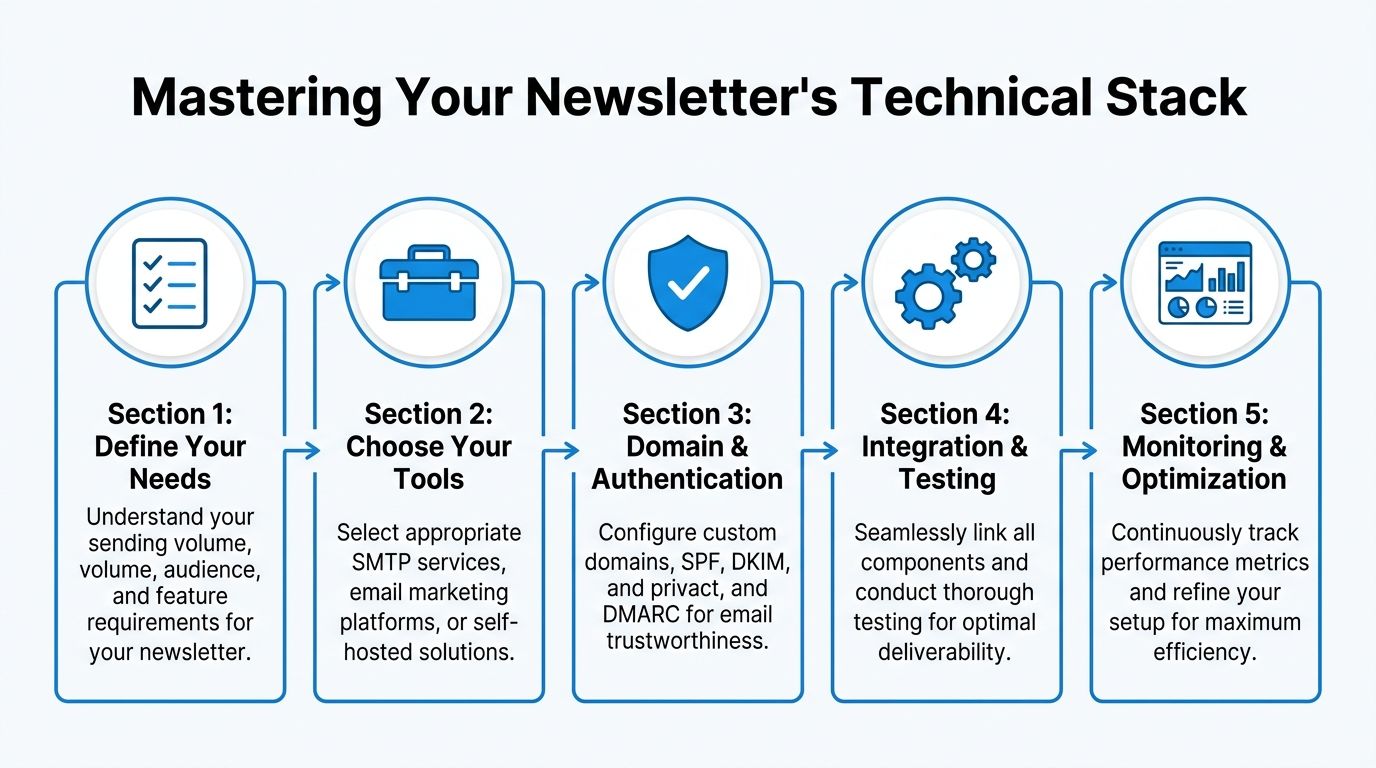
Newsletter software is not a cosmetic choice. It sets your margins, your failure points, and how much control you keep when a platform raises prices, limits features, or ties your sending reputation to other accounts.
Beginners usually buy convenience first and ask questions later. That works until the list grows, monthly software costs start eating into sponsorship revenue, and migration becomes painful because forms, automations, and sending are all locked into one vendor.
Rental model versus ownership model
A traditional ESP gives you speed. You sign up, import contacts, pick a template, and send. For a small list or a short-term project, that may be the right decision.
The trade-off shows up later.
With the rental model, pricing often climbs with subscriber count, sending infrastructure is usually shared, and policy changes can affect your operation overnight. You also have less direct control over how your sender reputation is built and protected.
The ownership model asks for more setup work. You choose the sending provider, connect your domain, configure authentication records, and route campaigns through infrastructure you control. It is less forgiving at the start, but it gives you clearer unit economics and fewer surprises once the newsletter becomes a real line of business.
One option in that category is Mailtani, which lets you connect providers such as Amazon SES, Resend, or Mailtrap, paying the provider directly instead of paying platform markup based on subscriber count.
What to set up in the first hour
Keep the first session focused on the parts that are expensive to fix later.
Mailgun's guide to SPF, DKIM, and DMARC explains why authenticated sending matters. These records help receiving servers verify that your messages are legitimate and reduce the odds that your newsletter gets treated like spoofed or low-trust mail.
Set up the stack in this order:
-
Choose a sending provider
Pick based on pricing, API reliability, account approval process, and whether you want to send marketing emails, product emails, or both through the same provider. -
Create a dedicated sending domain or subdomain
Using a separate sending identity keeps newsletter operations cleaner and limits collateral damage if you run into reputation issues later. -
Configure SPF, DKIM, and DMARC
Do this before you collect momentum. Fixing authentication after inconsistent sends is possible, but recovery is slower than getting it right early. -
Connect your email platform
Add the API key, test event tracking, and confirm that unsubscribe handling and bounce processing work as expected. -
Run internal tests
Check rendering, links, plain-text formatting, reply-to behavior, and inbox placement across a few major mailbox providers.
I have seen founders spend hours picking templates and almost no time verifying DNS. That is backwards. DNS work is boring, but boring setup protects profit.
Owning your setup gives you control, but it also gives you the operational work many hosted tools hide.
Cost comparison matters earlier than founders expect
A newsletter does not need a huge audience before software costs become a real constraint. That is the part many beginner guides skip because "start simple" sounds cleaner than "plan your margins."
A hosted ESP can be perfectly reasonable at low volume. It also becomes expensive fast if your newsletter grows before revenue catches up. Subscriber-based pricing punishes success. Infrastructure-led pricing usually tracks send volume more closely, which is often better for operators who want the newsletter to become an asset instead of a software bill.
Here is the practical comparison:
| Subscribers | Typical ESP Cost Pattern | Mailtani + Your Own Provider Cost Pattern |
|---|---|---|
| 2,000 | Usually low at first, then rises as the list grows or feature limits kick in | Fixed platform cost plus direct provider sending fees |
| 25,000 | Often meaningfully higher because pricing is tied to audience size | More predictable if the provider charges mainly by email volume |
That does not mean every publisher should self-manage every layer on day one. It means the stack decision affects long-term profit much earlier than many operators assume.
What not to overcomplicate
Early stack design should solve three jobs well:
- Collect subscribers reliably
- Send authenticated campaigns from infrastructure you control
- Track engagement, unsubscribes, bounces, and replies
Everything else can wait.
Visual automation builders, advanced branching logic, and heavy segmentation are useful once the newsletter has stable output and a clear revenue model. At the start, simpler systems usually win because they are easier to audit, cheaper to run, and less likely to break during growth.
Launching and Mastering Deliverability
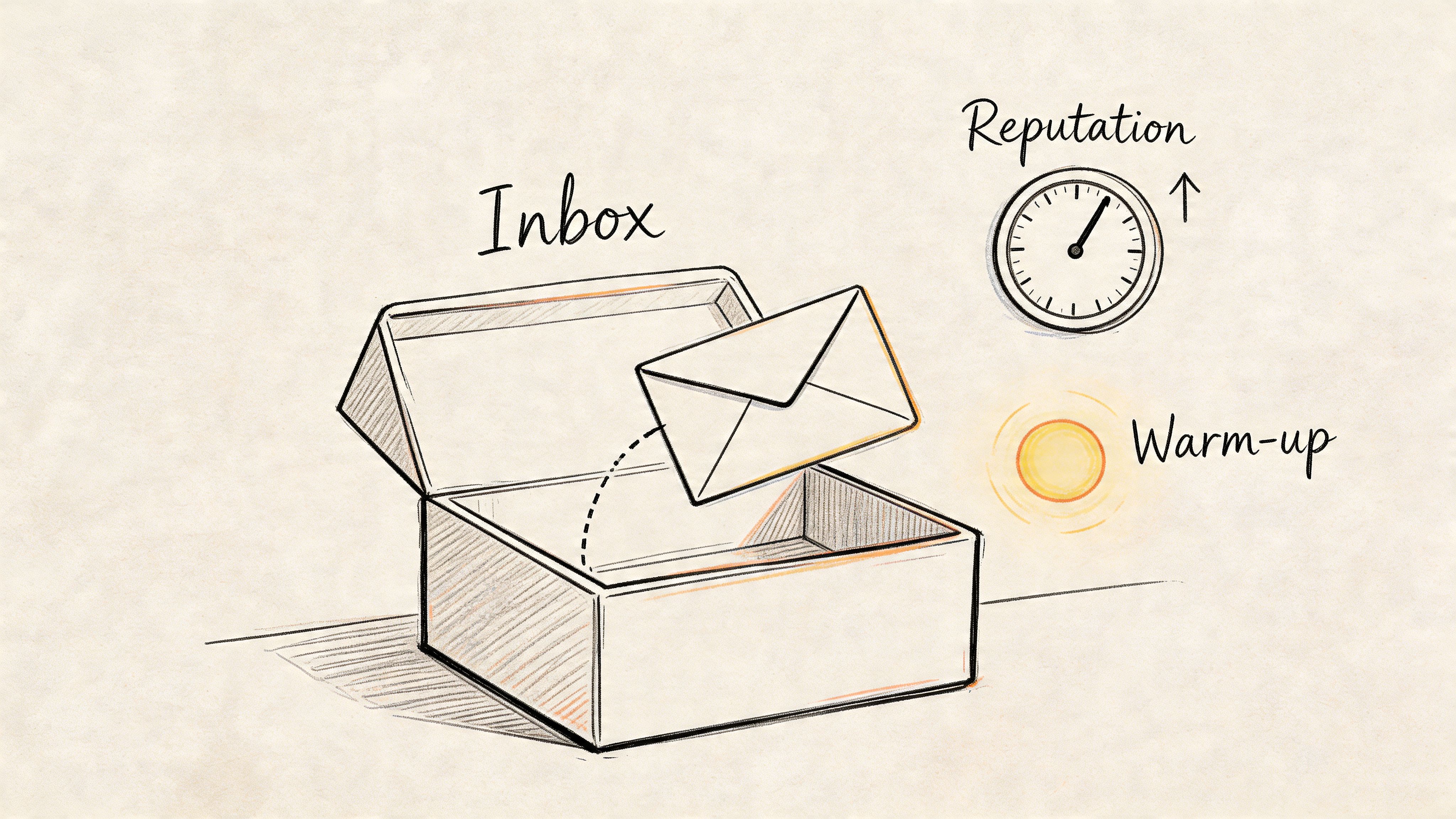
A newsletter launch is an inbox reputation exercise, not a marketing event.
Email can be extremely profitable, but inbox placement decides whether that economics shows up in the business. Litmus reports that email marketing returns strong ROI on average, and that only matters when mailbox providers trust your domain and sending behavior enough to place messages in the inbox, not the spam folder or promotions tab (Litmus email marketing ROI data).
Launch softly and earn trust with inbox providers
A new sending domain has no history. To Gmail, Outlook, and Yahoo, that means risk until you prove otherwise.
The mistake beginners make is treating launch day like a traffic event. They collect every contact they can find, send to all of them at once, and assume authentication alone will protect them. It will not. SPF, DKIM, and DMARC get you properly configured. They do not get you trusted.
Use a soft launch:
- Start with high-intent subscribers. Send first to people who filled out your form recently, confirmed interest clearly, or already know your brand.
- Increase volume in stages. Let positive engagement build before expanding to the next segment.
- Watch reply and click quality. Early positive signals help establish a healthy sender profile.
- Exclude weak contacts. Old imports, scraped lists, and vague lead sources are expensive mistakes during warm-up.
Early quality matters more than early scale.
That trade-off is easy to miss if you're focused on list growth. A smaller list with real intent gives you cleaner engagement data, lower complaint risk, and a better chance of keeping future sends profitable. If you own your sending setup, reputation damage is also your problem to fix, which is another reason to launch carefully.
Make the first list small but clean
Your first subscribers should come from explicit opt-in sources only. Website forms, product onboarding, newsletter-specific lead magnets, and direct invites from an existing audience are enough.
Do not force list size in the first month. A bloated list with weak intent creates soft bounces, low opens, more spam complaints, and slower recovery if performance drops. That is how a cheap launch turns into a costly deliverability cleanup.
The signup form needs to answer three questions fast:
- What will they get
- How often will they get it
- Why is it worth opening
Clear positioning does more than improve conversion. It filters out the wrong subscribers before they ever touch your infrastructure.
A quick visual walkthrough helps if you're new to the deliverability side:
Protect reputation in the first month
The first month is operational work. Send, observe, adjust, repeat.
Keep the launch sequence simple:
| Week | Focus | What to watch |
|---|---|---|
| Week 1 | Small send to warm contacts | Opens, replies, bounce issues |
| Week 2 | Slight volume increase | Inbox placement and unsubscribes |
| Week 3 | Add another engaged segment | Subject line response and clicks |
| Week 4 | Normalize publishing rhythm | Whether engagement stays steady |
If performance drops, do not answer that problem with more volume. Check the source of those subscribers, look at complaint rates, review your subject lines, and confirm your authentication records are still passing. Sometimes the fix is as simple as cutting a weak segment. Sometimes you need to slow sending for a week and rebuild engagement with your best readers.
Deliverability is reputation plus consistency. Operators who respect that early usually keep costs lower later, because they spend less time repairing domains, replacing infrastructure, or burning through paid tools trying to solve a trust problem they created at launch.
Scaling with Smart Automation and Analytics
Once the newsletter is landing reliably, the next job is making each subscriber more valuable. That doesn't mean adding complexity for its own sake. It means building a feedback loop.
Relevant newsletters can reach 30% to 40% open rates, and 65% of marketers report better open rates from segmented lists. The same benchmark set notes that limiting emails to 1 to 2 CTAs and personalizing subject lines with a first name can lift opens by up to 47%, according to Omnisend's email open rate benchmarks.

Start with one useful automation
The first automation should usually be a welcome sequence. Not a giant funnel. Just a short onboarding path that helps a new subscriber understand what they signed up for and what to do next.
A good welcome sequence often does three jobs:
- Sets expectations about content and frequency
- Delivers the promised lead magnet or first resource
- Creates an early action, such as replying, clicking a preferred topic, or visiting a key page
That reply or click matters because it gives you segmentation data quickly.
Segment by behavior, not assumptions
Most beginners segment by demographics because it feels clean. Behavior is better.
Useful early segments include:
- New subscribers who need onboarding
- Recent openers who are clearly interested
- Frequent clickers who are signaling buying or research intent
- Inactive subscribers who may need re-engagement or suppression
Analytics are no longer merely decorative; they become operational. If a segment consistently clicks content about deliverability and ignores monetization topics, the signal is obvious. Give them more of what they respond to.
Send fewer generic emails. Send more relevant ones to smaller groups.
Use metrics as editorial feedback
Three metrics matter early.
| Metric | What it tells you | What to do with it |
|---|---|---|
| Open rate | Whether subject line, reputation, and topic match interest | Test tighter subjects and clearer positioning |
| Click-through rate | Whether the content and CTA earned action | Reduce competing links and sharpen the offer |
| Reply rate | Whether trust and relevance are building | Ask better questions and invite specific responses |
One common mistake is stuffing too many calls to action into one issue. If every email asks the reader to read a blog post, watch a video, book a demo, follow on social, and check a product page, you create friction. A newsletter usually performs better when each issue has one primary job.
Another mistake is reading metrics without context. An open may mean the subject line worked. A click means the body created enough interest to act. A reply often means you've built actual relationship value.
Good newsletter operators don't just track data. They let the data change what they write next.
Monetization Compliance and Long-Term Strategy
A newsletter becomes a business asset when revenue, trust, and operations reinforce each other. If one breaks, the rest usually follow.
There are four practical monetization paths to evaluate:
- Sponsorships. Best when you have a clear niche and consistent reader attention.
- Affiliate offers. Works when you already recommend products your audience would buy anyway.
- Your own products or services. Often the strongest fit for operators selling software, consulting, or education.
- Paid subscriptions. Works when the information is specialized enough that readers will pay for direct access.
The right choice depends on audience intent. A DTC operator newsletter may naturally support services, templates, or software. A personality-driven essay newsletter may fit subscriptions or sponsors better. Don't force the monetization model before the audience behavior makes it obvious.
Compliance is part of the product
Email law and consent practices aren't side issues. They're operational requirements.
Keep the basics tight:
- Use opt-in subscribers
- Honor unsubscribes quickly
- State who is sending the email
- Be clear about what subscribers are joining
- Respect regional requirements such as GDPR and CAN-SPAM
Compliance also improves list quality. People who knowingly subscribed are more likely to engage. People who feel tricked are more likely to ignore, mark spam, or leave.
The long-term strategy is straightforward. Build a narrow newsletter, own the critical infrastructure, keep the list clean, and monetize in a way that matches reader intent. That combination creates something durable.
Frequently Asked Questions
How often should I send my newsletter
Start with a cadence you can sustain without rushing quality. Bi-weekly is a practical starting point for many operators. Consistency matters more than ambition.
Should I use a broad topic at first to attract more readers
Usually no. Narrow topics tend to attract the right readers faster because the value is obvious. Broad positioning often creates weak engagement.
What should I write in the first few issues
Write the material that proves your point of view. Teardowns, templates, opinionated breakdowns, and answers to common audience questions work well early.
How technical does setup need to be
You need enough setup to send authenticated email properly and measure engagement. You don't need a complicated stack, but you do need to take deliverability seriously.
When should I think about monetization
Before launch, but lightly. You should know the likely business model from the start, even if revenue comes later. That keeps your content, audience, and infrastructure choices aligned.
If you want to build a newsletter without paying steep per-subscriber markup, Mailtani is worth a look. It lets you run broadcasts, automations, forms, and segmentation while using your own provider account, so you keep control over infrastructure, deliverability, and sending costs from the beginning.
